Introduction
Every growing business eventually reaches a point where spreadsheets become difficult to manage, manual processes start causing delays, and teams spend more time working around systems than using them.
At that stage, business owners face an important decision: should they purchase an existing software solution or invest in custom software built specifically for their operations?
The answer isn't always obvious. Off-the-shelf software can provide a quick start and lower upfront costs. Custom software offers flexibility, scalability, and control that packaged solutions often cannot match.
In 2026, with digital transformation accelerating across every industry, choosing the right software approach can significantly impact productivity, customer experience, and long-term growth.
This guide explores the advantages, limitations, and business considerations of both approaches to help you make an informed decision.
What Is Off-the-Shelf Software?
Off-the-shelf software refers to pre-built applications designed for a broad audience. Examples include accounting software, CRM platforms, project management tools, and inventory management systems.
These products are developed to solve common business problems and are typically available through subscription-based pricing models.
Examples include:
- Customer relationship management tools
- Accounting platforms
- Project management systems
- Help desk software
- Marketing automation platforms
Because these solutions serve thousands of businesses, they are designed around generalized workflows rather than your specific business processes.
What Is Custom Software?
Custom software is developed specifically for a particular business and its unique requirements.
Instead of adapting your processes to fit the software, the software is built around the way your organization already operates—or how you want it to operate in the future.
Custom software may include:
- ERP systems
- CRM platforms
- Inventory management solutions
- Workflow automation tools
- Customer portals
- Business intelligence dashboards
- Industry-specific applications
The result is a solution tailored to your goals, team structure, and operational requirements.
The Real Cost Comparison
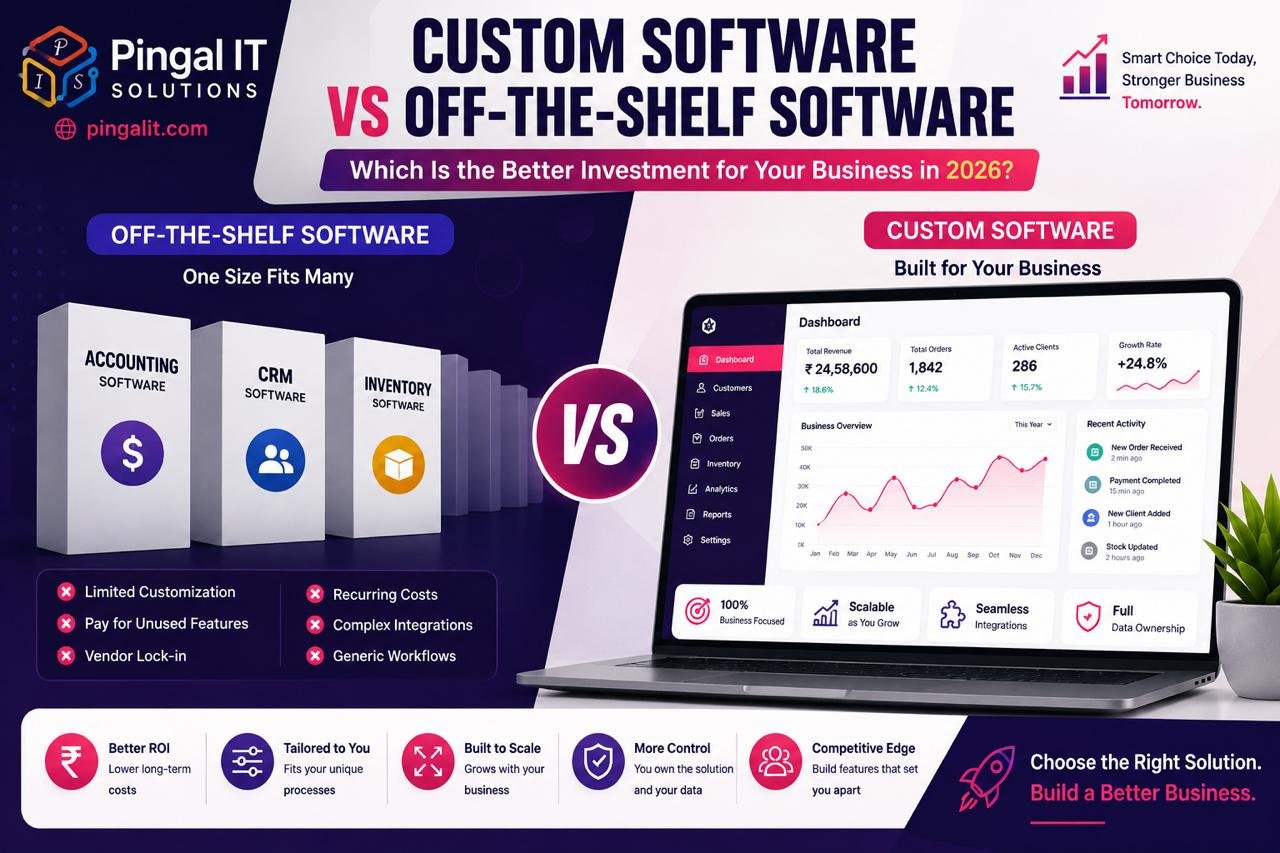
Many businesses assume off-the-shelf software is always cheaper. While this may be true initially, long-term costs often tell a different story.
| Factor | Off-the-Shelf Software | Custom Software |
|---|---|---|
| Initial Investment | Low | Higher |
| Monthly Fees | Recurring | Minimal or none |
| Customization | Limited | Fully flexible |
| Scalability | Depends on vendor | Designed around business growth |
| Ownership | Vendor-controlled | Business-owned |
| Integration Flexibility | Restricted | Unlimited |
Over several years, subscription fees, user licensing costs, and third-party add-ons can make packaged software significantly more expensive than expected.
When Off-the-Shelf Software Makes Sense
1. Standard Business Processes
If your workflows closely match industry standards, existing solutions may be sufficient.
2. Immediate Deployment Requirements
Businesses that need a solution quickly often benefit from ready-made software.
3. Limited Budget Constraints
For startups validating an idea or operating with limited resources, subscription software can provide an affordable starting point.
4. Small Teams
Organizations with simple requirements may not need extensive customization initially.
When Custom Software Becomes the Better Choice
1. Unique Business Processes
If your operations differ significantly from industry norms, forcing your team into generic software often creates inefficiencies.
2. Multiple Systems Need Integration
Businesses frequently use separate systems for sales, operations, finance, inventory, and customer management.
Custom software can unify these systems into a single platform.
3. Rapid Growth Plans
Growing businesses require systems capable of evolving alongside new departments, users, and operational complexity.
4. Competitive Advantage
Custom software enables unique workflows and capabilities that competitors cannot simply purchase and replicate.
The Hidden Problems with Generic Software
Many businesses encounter challenges after adopting off-the-shelf solutions:
- Paying for features they never use
- Missing features they actually need
- Increasing subscription costs
- Data scattered across multiple platforms
- Vendor lock-in
- Limited reporting capabilities
- Workflow inefficiencies
Over time, employees often create spreadsheets and manual processes to compensate for software limitations—reducing the productivity gains the software was meant to deliver.
How Custom Software Creates Long-Term Value
Custom software is not simply a technology investment. It is an operational investment.
Benefits often include:
- Reduced manual work
- Improved process consistency
- Faster decision-making
- Better reporting and analytics
- Higher employee productivity
- Improved customer experiences
- Greater scalability
Unlike generic software, custom solutions evolve with the business instead of forcing the business to adapt continuously.
Questions to Ask Before Choosing
Before selecting any solution, consider the following:
- Will this software still meet our needs in three years?
- Can it integrate with our existing systems?
- How much customization do we require?
- What are the long-term subscription costs?
- Who owns the data and system?
- How difficult would migration be later?
- Will this improve efficiency or create additional workarounds?
The answers often reveal which approach provides the better long-term value.
How Pingal IT Solutions Helps Businesses Build the Right Solution
At Pingal IT Solutions, we help businesses evaluate whether custom development or existing software is the right fit for their specific requirements.
When custom development is the best option, we design scalable, secure, and maintainable applications tailored to business objectives rather than generic assumptions.
Our focus is not simply writing code. It is creating software that improves efficiency, supports growth, and delivers measurable business outcomes.
Conclusion
There is no universal answer to the custom versus off-the-shelf software debate.
For some businesses, packaged solutions provide the functionality they need at an affordable cost. For others, custom software becomes the foundation for operational efficiency and long-term growth.
The key is evaluating not only today's requirements but tomorrow's ambitions.
If your business is struggling with disconnected systems, inefficient workflows, or software limitations, it may be time to explore a solution designed specifically for the way you work.
Talk to Pingal IT Solutions to discuss your requirements and discover which approach makes the most sense for your business.