API Integrations in 2026: How Connected Systems Save Businesses Time, Money, and Mistakes
Introduction
Modern businesses rely on more software than ever before.
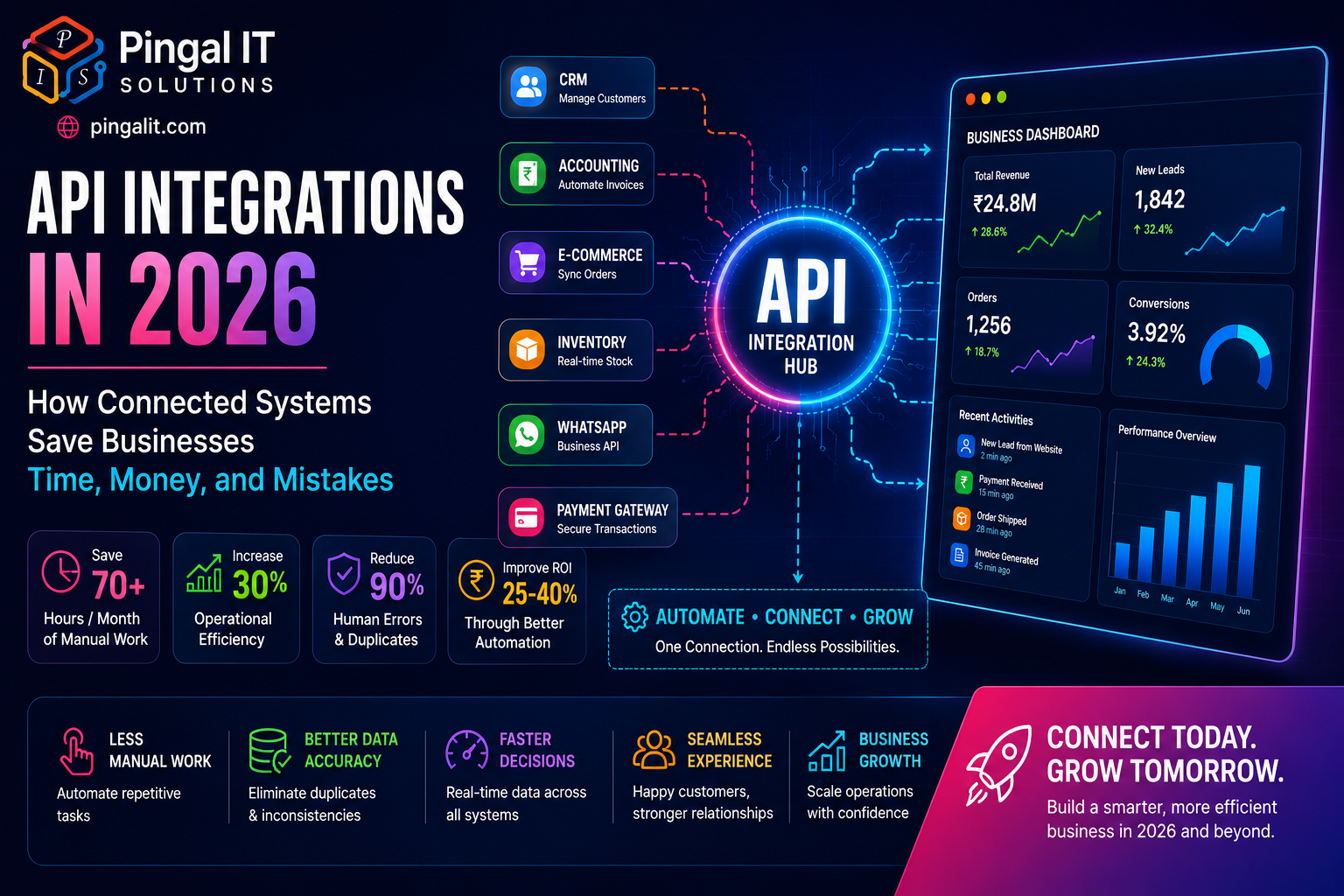
A typical small or medium-sized business may use a CRM to manage customers, accounting software for finances, WhatsApp for communication, a payment gateway for transactions, inventory software for operations, and marketing platforms for lead generation.
Individually, these tools solve important problems. Collectively, they often create a new one: data silos.
When systems don't communicate with each other, teams end up manually copying information between platforms, generating duplicate records, making avoidable mistakes, and wasting valuable time.
This is where API integrations become critical.
In 2026, businesses that successfully connect their systems operate faster, make better decisions, and scale more efficiently than businesses relying on disconnected software.
This guide explains what API integrations are, why they matter, and how connected systems create measurable business value.
What Is an API Integration?
API stands for Application Programming Interface.
While the term sounds technical, the concept is surprisingly simple.
An API acts as a messenger between two software systems, allowing them to exchange information automatically.
For example:
- A customer fills out a contact form on your website.
- The information is automatically sent to your CRM.
- Your CRM creates a lead record.
- The sales team receives an instant notification.
- A follow-up email is triggered automatically.
Without API integrations, every one of these steps might require manual work.
With integrations, the entire workflow happens in seconds.
Why Businesses Struggle With Disconnected Systems
Most businesses don't start with a complete technology ecosystem.
They adopt tools gradually:
- CRM for customer management
- Accounting software for invoices
- E-commerce platforms for online sales
- Inventory management software
- Email marketing tools
- Helpdesk systems
Over time, these systems become isolated islands of information.
Common problems include:
- Duplicate data entry
- Inconsistent records
- Delayed reporting
- Human errors
- Reduced productivity
- Lack of visibility across departments
The larger the business grows, the more costly these inefficiencies become.
A Real-World Example of the Problem
Imagine a company selling products online.
When an order is placed:
- The website records the sale
- The payment gateway processes payment
- The inventory system must update stock
- The accounting software needs invoice information
- The CRM should update customer history
- The support system should have access to order details
If these systems aren't integrated, employees must manually transfer information between platforms.
Each manual step introduces:
- Delays
- Errors
- Additional costs
- Customer frustration
API integrations eliminate these gaps.
The Business Benefits of API Integrations
1. Reduced Manual Work
Manual data entry is one of the biggest hidden costs in business operations.
Employees spend countless hours moving information between systems.
API integrations automate repetitive tasks and allow teams to focus on higher-value activities.
The result:
- Higher productivity
- Lower operational costs
- Faster execution
2. Better Data Accuracy
Human error is unavoidable when information is entered multiple times.
Misspelled names, incorrect amounts, duplicate records, and outdated information create ongoing issues.
Integrated systems ensure data is synchronized automatically and consistently.
3. Faster Decision-Making
Business leaders need accurate information in real time.
When data exists across multiple disconnected systems, reporting becomes difficult and delayed.
Connected platforms create a single source of truth, enabling faster and more confident decisions.
4. Improved Customer Experience
Customers expect fast responses and accurate information.
Integrated systems allow teams to:
- Access customer history instantly
- Track orders in real time
- Provide faster support
- Deliver personalized experiences
The result is higher satisfaction and stronger customer retention.
Common Business Systems That Should Be Connected
| System | Typical Integration Partner | Business Benefit |
|---|---|---|
| Website | CRM | Automatic lead capture |
| CRM | Email Marketing | Targeted campaigns |
| E-Commerce | Inventory Software | Real-time stock updates |
| Payment Gateway | Accounting Software | Automated bookkeeping |
| HR Software | Payroll System | Reduced administrative work |
| Support Desk | CRM | Complete customer visibility |
These integrations often deliver immediate operational improvements.
The Hidden Cost of Not Integrating Systems
Many businesses underestimate the cost of disconnected software.
The expenses aren't always visible on financial statements, but they affect profitability every day.
Examples include:
- Hours spent copying data
- Delayed customer responses
- Incorrect reports
- Duplicate work
- Missed opportunities
- Employee frustration
What appears to be a technology problem often becomes a business performance problem.
Custom Integrations vs Native Integrations
Not all integrations are created equally.
Native Integrations
Many software platforms provide built-in integrations.
Advantages:
- Fast implementation
- Lower upfront cost
- Simpler maintenance
Limitations:
- Limited customization
- Restricted workflows
- Vendor dependency
Custom Integrations
Custom integrations are developed specifically for your business requirements.
Advantages:
- Tailored workflows
- Greater flexibility
- Support for unique business processes
- Better scalability
Custom integrations are particularly valuable when businesses rely on multiple specialized systems.
Common API Integration Mistakes Businesses Make
1. Integrating Without a Clear Objective
Technology should solve business problems, not create new complexity.
Every integration should have a defined business outcome.
2. Ignoring Data Quality
Connecting systems doesn't automatically improve bad data.
If data quality issues exist before integration, they often spread faster afterward.
3. Overcomplicating Workflows
Some businesses attempt to automate every process immediately.
Successful integrations typically begin with the highest-value workflows.
4. Neglecting Security
Integrated systems exchange sensitive information.
Security, authentication, and access controls must be considered from the beginning.
How API Integrations Support Business Growth
As businesses grow, complexity increases.
New departments, new tools, new customers, and new processes create additional operational demands.
Businesses that rely heavily on manual processes eventually reach a scalability limit.
API integrations help remove that limit.
Benefits include:
- Scalable operations
- Faster onboarding
- Better reporting
- Improved collaboration
- Reduced operational bottlenecks
In many cases, integrations provide more value than purchasing additional software.
The Future of API Integrations in 2026
Modern businesses increasingly depend on connected ecosystems rather than standalone applications.
Emerging trends include:
- AI-powered workflow automation
- Real-time analytics synchronization
- Cloud-native integrations
- Low-code and no-code integration platforms
- Event-driven architectures
Businesses that invest in connected systems today will be better positioned to adopt future technologies tomorrow.
How Pingal IT Solutions Helps Businesses Build Connected Systems
At Pingal IT Solutions, we help businesses eliminate inefficiencies caused by disconnected software.
We design and develop secure, scalable integrations that connect websites, CRMs, ERP systems, accounting platforms, payment gateways, inventory software, and other critical business applications.
Our goal is not simply connecting systems—it is creating workflows that improve productivity, reduce operational costs, and support long-term growth.
Every integration is designed around real business objectives rather than technical complexity.
Conclusion
In 2026, business success depends increasingly on how well your systems communicate with each other.
Disconnected software creates inefficiencies that slow growth, increase costs, and reduce visibility.
API integrations eliminate these barriers by enabling systems to exchange information automatically and accurately.
The result is a business that operates faster, makes better decisions, and delivers a stronger customer experience.
If your team spends too much time moving information between systems, your technology may be working harder than it should.
Talk to Pingal IT Solutions to discover how API integrations can streamline your operations and help your business scale more efficiently.